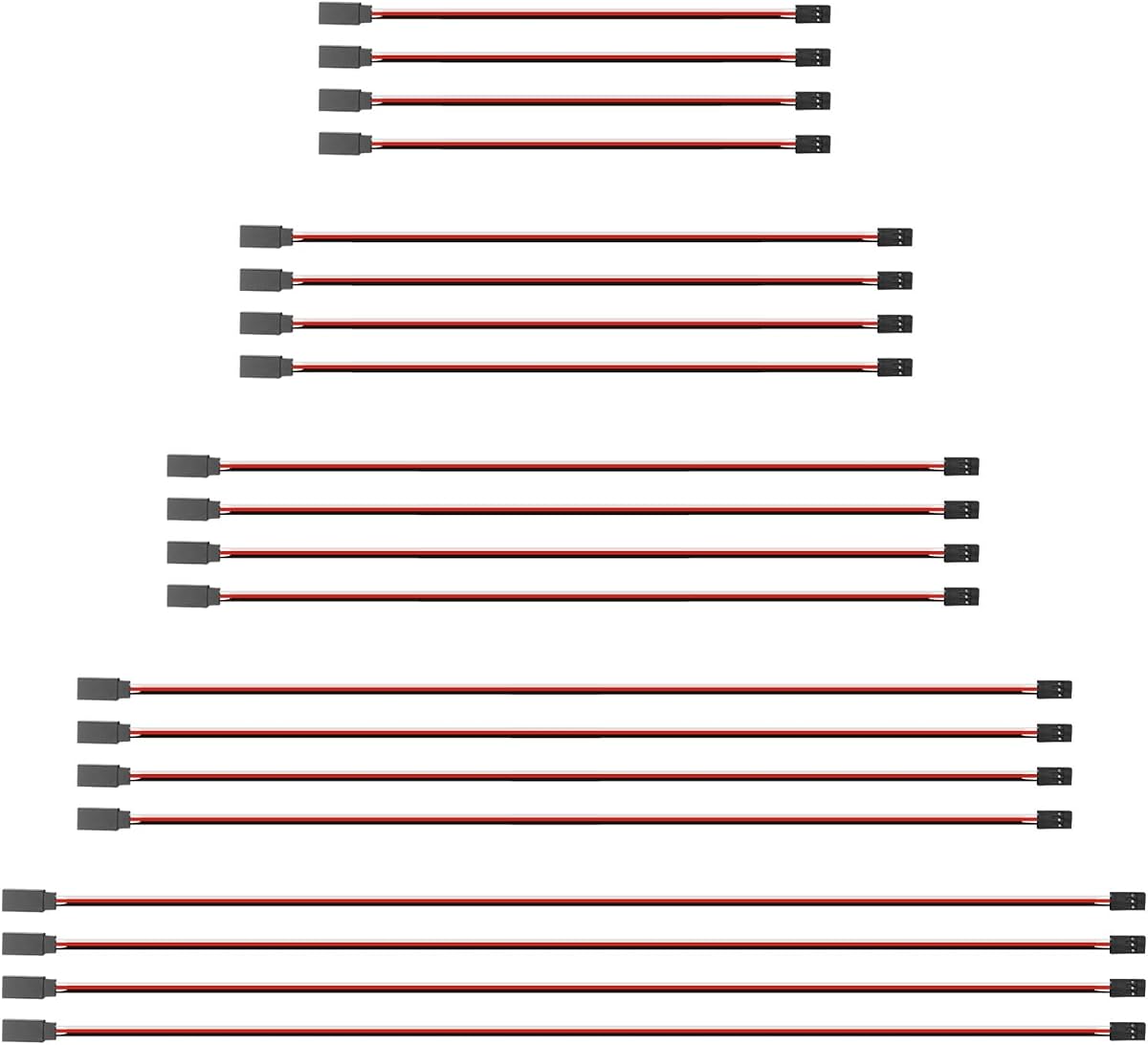
20 PCS 3-Pin Servo Extension Cable
4.8Editor score
Five length options
Twenty-piece assortment
Female-to-male connectors
Servo Extension Cable guide compares 10 options for RC cars, planes, helicopters, and drones, highlighting length variety, connector design, wire quality, and
Servo extension cables make awkward wiring layouts easier by carrying power, ground, and control signals between compatible RC components. A useful cable should offer a secure connection, dependable conductor construction, a length suited to the model, and enough flexibility for repeated installation or repair work.
This guide compares ten extension cable and wiring kits using the information supplied for each product. The evaluation focuses on connector configuration, included lengths, wire construction, pack quantity, compatibility claims, and practical considerations such as routing, strain relief, and installation.
Each review explains who the cable is best suited to, where it stands out, and where buyers may need to make compromises. The top selections reflect variety across the list, while current prices and availability can change, so readers should verify those details before ordering.
4.8Editor score

4.7Editor score

4.7Editor score
The comparison below highlights each kit's cable format, length coverage, conductor construction, and stated RC compatibility, helping buyers identify the most suitable option for a new build, repair, or compact wiring layout.


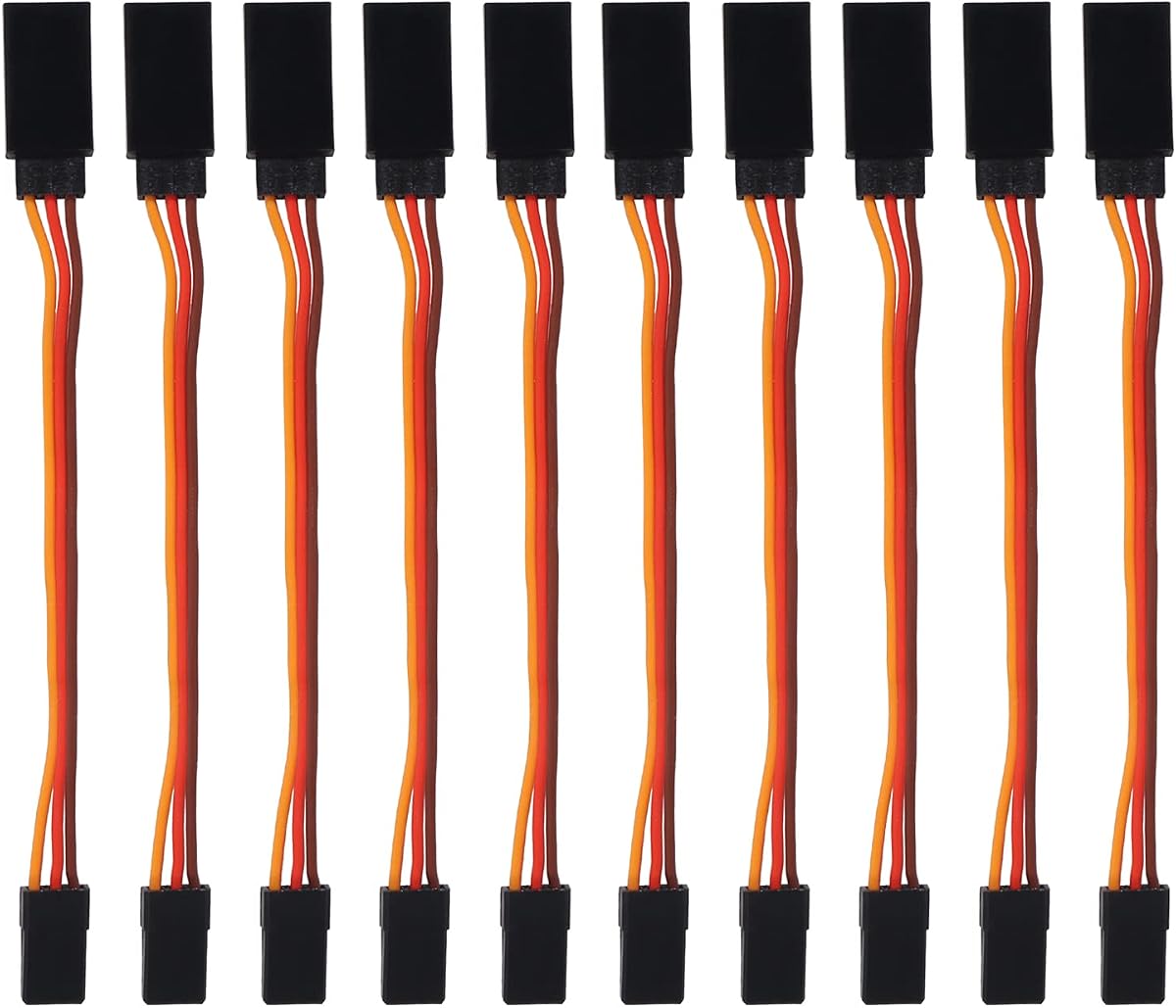
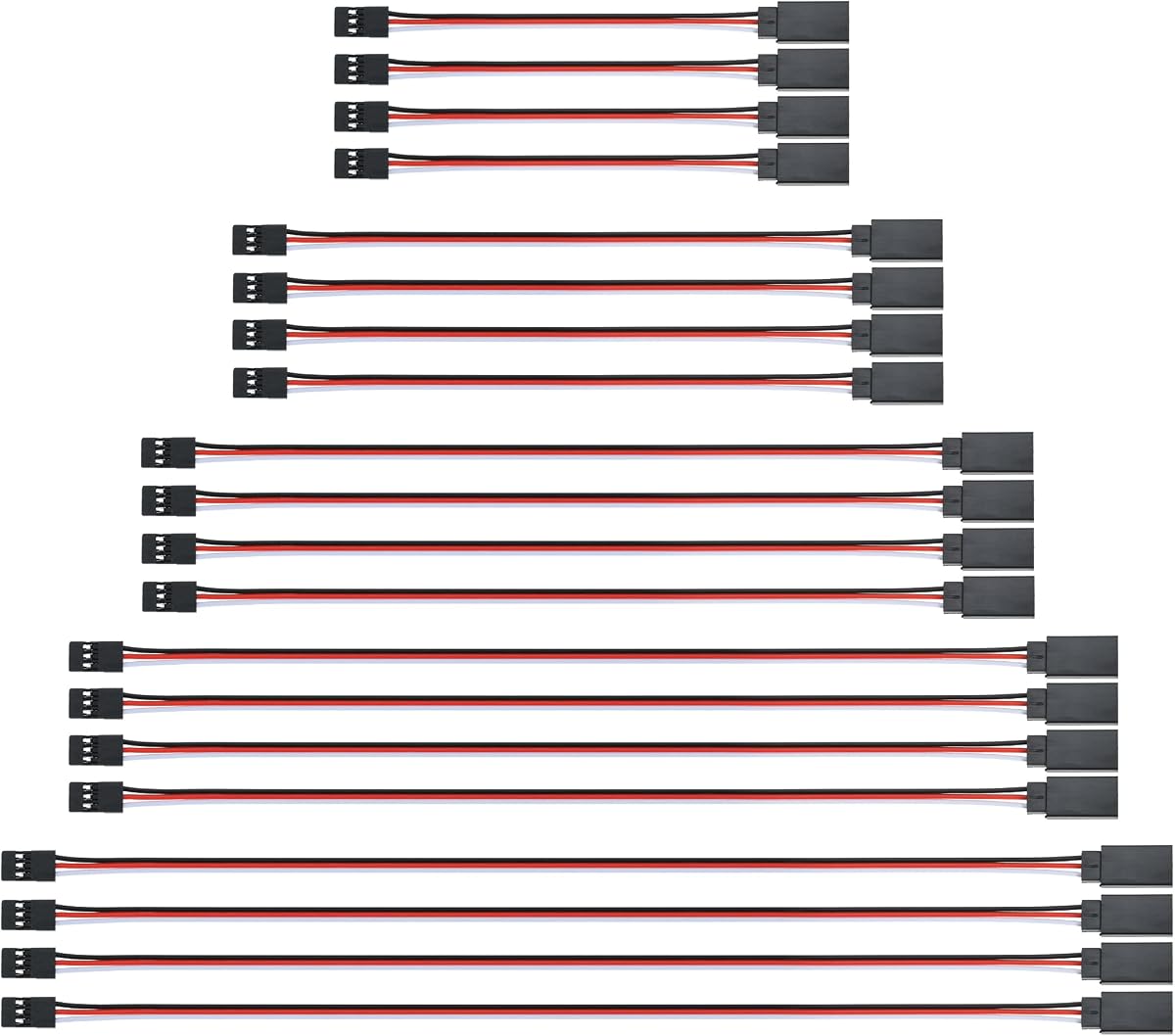

This 20-piece servo extension cable kit earns a 4.8 rating and stands out as the broadest budget-friendly assortment in the group. It includes four cables at each of five stated lengths, giving builders options for short links, moderate reach, and longer routing around receiver compartments, control linkages, or frames.
We may earn a commission when you buy through this link, at no additional cost to you.
Its central strength is practical coverage rather than specialized engineering. The leads use a three-wire female-to-male configuration for connection to compatible receivers, servos, control boards, and steering components. The product information also identifies compatibility with Futaba and JR servo systems, remote-control cars, airplanes, and helicopters.
The trade-off is that all twenty leads share the same basic construction, so buyers needing particularly heavy-gauge wire, reinforced strain relief, or locking features may need a more specialized option. The angled three-pin connectors are designed to discourage incorrect orientation, but users should still check the fit before applying power.
This is an especially strong recommendation for hobbyists who want several lengths without managing many separate accessories. It suits bench repair, model building, and general RC wiring projects, making it the most versatile selection for the money-conscious buyer.
Having four cables at each of five lengths makes it easier to match a connection to the available space. Short leads reduce clutter, while the longest options help a servo reach a receiver or control component without leaving excessive wire inside the model.
The stated compatibility with common Futaba and JR servo arrangements expands the kit's usefulness across cars, planes, helicopters, and other remote-control projects. It is a practical addition to a hobbyist's repair inventory.
We may earn a commission when you buy through this link, at no additional cost to you.
This 22-piece, five-length servo extension cable set carries a 4.8 rating and is distinguished by its inclusion of 100-centimeter leads. The range begins at 6 centimeters and also includes 15-, 30-, and 50-centimeter options, covering both close connections and installations that require greater reach.
We may earn a commission when you buy through this link, at no additional cost to you.
All leads use three-pin female-to-male connectors with an angled design intended to help prevent incorrect installation. The information states compatibility with Futaba and JR servo connections as well as plane, helicopter, receiver, and remote-control car applications.
Its main limitation is that two 100-centimeter cables may be more length than some compact models can accommodate. Without strain relief or a locking clip mentioned in the product data, the longest leads also require neat routing to prevent pulling at the connector. Nevertheless, the range makes this set valuable for larger airframes, ground vehicles, and custom control boards.
Choose this kit when having a one-meter option is important, especially for scale models with separated receiver and servo locations. It is also a good general-purpose assortment for builders who prefer several standard wire lengths in one package.
The 100-centimeter leads provide meaningful extra reach in larger aircraft, ground vehicles, and custom installations. They are especially helpful when a servo cannot be placed close to its receiver without changing the model's mechanical layout.
Angled three-pin connectors can make tight installations more manageable and help users identify the correct orientation. The keyed geometry should be checked against the receiver or servo before pressing the parts together.
We may earn a commission when you buy through this link, at no additional cost to you.
This 16-piece extension and Y-harness set earns a 4.7 rating and is the most system-oriented option in the comparison. Rather than supplying only single-ended extensions, it includes one-to-two Y-harness splitters alongside multiple extension leads, allowing a builder to organize more than one servo connection.
We may earn a commission when you buy through this link, at no additional cost to you.
The kit combines 30-core and 60-core wiring. Its listed components include three 2.76-inch and three 5.9-inch Y-harness splitters, along with five 3.54-inch and five 5.9-inch three-pin extension cables. The product information specifically cites JR, Futaba, and Spektrum compatibility and identifies RC cars, airplanes, drones, and Traxxas-style models as intended applications.
Unlike simple bulk extension assortments, this package can simplify a receiver that needs to feed multiple servos. The limitation is that the included leads are comparatively short, so it is better suited to compact layouts and nearby components than large models requiring long extensions. Y-harnesses also demand more careful connector orientation than a simple one-to-one lead.
This is the best choice for a builder who needs both extension cables and branching capability in one organized kit. It is particularly relevant to multi-servo aircraft, cars, and drones where clean branching can reduce clutter and simplify the receiver layout.
The inclusion of Y-harness splitters distinguishes this package from basic extension sets. They allow a single receiver output to reach multiple compatible servos, which can be useful in models with several steering or control surfaces.
Both 30-core and 60-core wires are represented, giving builders a choice between the assortment's included constructions. The stated low-resistance and stable-signal features are particularly relevant when organizing more involved RC wiring systems.
We may earn a commission when you buy through this link, at no additional cost to you.
This Tecunite 20-piece set has a 4.8 rating and focuses on straightforward installation with standard three-pin servo connectors. Its most notable feature is the polarization key built into the connector design, intended to help users avoid inserting a cable backward and potentially damaging connected electronics.
We may earn a commission when you buy through this link, at no additional cost to you.
The product information lists five practical lengths: 10, 15, 30, 50, and 60 centimeters. Although one description phrase refers to six lengths, the enumerated list contains five, so buyers should use the stated measurements when planning a layout. The flexible 26 AWG wire is designed for repeated bending and general RC durability.
Compatibility is described as universal for standard three-pin servos, with applications including RC cars, airplanes, helicopters, and receiver connections. A limitation is that the connector key aids orientation but does not provide the physical locking behavior associated with a retention clip. Buyers should also verify connector clearance in especially compact installations.
This is a good pick for users who value foolproof orientation more than premium conductor specifications. The combination of five lengths and twenty pieces also makes it a well-rounded option for repairs and projects involving several differently placed servos.
A connector polarization key provides a physical cue for correct alignment. It is a useful safeguard when working in a confined model where a cable's orientation may be difficult to see.
The listed range covers short, medium, and long routes, with 10 centimeters for compact connections and 60 centimeters for broader reach. The range supports tidy layouts without requiring every project to use the same excess length.
We may earn a commission when you buy through this link, at no additional cost to you.
The Frienda 15-piece servo extension cable set carries a 4.8 rating and centers on a single standardized length. Every cable measures approximately 300 millimeters, or 11.8 inches, making the package easy to plan around when a builder repeatedly needs the same modest extension.
We may earn a commission when you buy through this link, at no additional cost to you.
The leads have a three-pin male-to-female arrangement. Their stated uses include connecting compatible Futaba and JR servos, linking receivers, and joining components in airplanes, helicopters, remote-control cars, and control-panel applications. The black-and-red color description provides a simple visual reference for the cable set.
The obvious trade-off is the absence of shorter and longer alternatives. A builder with a very tight receiver bay or a distant servo may need to manage excess cable or source another length separately. The product information also does not emphasize advanced locking, shielding, or unusually heavy-gauge construction.
This kit is best for maintenance-minded hobbyists who want a dependable reserve of identical extension leads. It is especially convenient for board-to-board work, repeated replacements, and standardized wiring layouts where one length works consistently.
Using the same 11.8-inch length for every cable simplifies inventory and allows a replacement to be installed without a second measurement. It also works well for modest extension requirements in several classes of RC model.
Fifteen identical leads provide enough material for multiple repairs or for keeping several matching extensions installed at once. The male-to-female format is particularly straightforward when extending an existing lead.
We may earn a commission when you buy through this link, at no additional cost to you.
This BackBayRC five-pack earns a 4.7 rating and is the most specialized premium construction in the list. Each 45-centimeter, or 18-inch, lead uses 20 AWG, 100-strand conductors within a twisted three-wire servo cable, emphasizing flexibility and resistance to fatigue during movement, rebuilds, and crashes.
We may earn a commission when you buy through this link, at no additional cost to you.
Its integrated safety clip physically locks the male and female plugs together, addressing a common weakness in conventional servo connections. The product also features gold-plated pins for lower-resistance, corrosion-resistant contact and twisted wiring intended to reduce electrical interference between the receiver and servo.
Silicone insulation adds another practical advantage because it bends cleanly around frames, stacks, and battery trays without readily kinking. The trade-off is that this is a five-cable pack with a single fixed length, so it is less versatile than the larger mixed-length assortments. It also focuses on JR-style three-pin plugs rather than providing several connector formats.
This is the strongest recommendation for builders who work on vibration-prone vehicles, frequently move their electronics, or want added retention at the connection. It is a premium choice for new builds, repairs, and upgrades where wire resilience and secure mating matter.
The integrated safety clip helps keep the male and female plugs connected during fast runs, rough landings, and bumpy trails. That physical retention is a meaningful upgrade for installations where a loose servo connection could interrupt control.
The 100-strand, 20 AWG conductors and silicone insulation are designed to tolerate repeated flexing while remaining easy to route. These properties suit compact frames, battery areas, and installations that are likely to be opened and worked on repeatedly.
We may earn a commission when you buy through this link, at no additional cost to you.
This 15-piece extension set has a 4.7 rating and emphasizes flexible, stranded wiring. Each lead is described as using three groups of 60-core tinned copper, with a 22 AWG gauge, twisted-pair construction, and tinned plugs at both ends to strengthen oxidation resistance and interference handling.
We may earn a commission when you buy through this link, at no additional cost to you.
The connectors are male-to-female and compatible with JR and Futaba-style arrangements. The product is listed at 300 millimeters, or approximately 11.8 inches, although one description phrase inconsistently displays 300 centimeters. The repeated dimensions and title make 300 millimeters the sensible value to use when planning a build.
Compared with standard three-strand servo wire, the high strand count should provide additional flexibility in tight models. The trade-off is that all fifteen cables have the same length, so this set is less helpful for installations with sharply different reach requirements. Buyers also receive no Y-splitters or alternative connector formats.
This is a good choice for builders who want flexible leads and tinned contacts for control boards, receiver links, and standard RC servos. It is particularly attractive for repair inventories where several matching extensions are likely to be used.
Using numerous fine strands makes the leads more flexible than conventional solid-core alternatives. That can make tight routing and repeated handling easier in aircraft, cars, and control-board installations.
Tinned copper conductors and tinned connector contacts are intended to improve oxidation resistance. The twisted arrangement also supports the product's stated goal of reducing electromagnetic interference.
We may earn a commission when you buy through this link, at no additional cost to you.
The ACEIRMC 10-piece set carries a 4.6 rating and specializes in short connections. Every cable measures 10 centimeters, which can be valuable inside compact RC vehicles, aircraft, and control-board projects where a full-size extension would add clutter or interfere with moving components.
We may earn a commission when you buy through this link, at no additional cost to you.
The leads have three-pin female-to-male connectors, and their angled geometry is intended to make the correct orientation easier to identify. Stated applications include Futaba and JR servo connections in planes, helicopters, remote-control cars, receivers, and control boards.
The clear limitation is reach. A 10-centimeter cable is well suited to crossing a small gap or moving a servo slightly within a model, but it cannot solve a substantial routing distance. The product information does not identify a locking clip or unusually flexible conductor construction, so it is better regarded as a straightforward short-extension option.
Choose this set when space is tight and several small adjustments are needed at once. It is also a sensible basic repair accessory for builders who already own longer extensions and want a convenient supply of short leads.
A 10-centimeter lead is long enough to extend a connection while minimizing excess wire in a tight compartment. This can help prevent loose loops from interfering with linkages, battery packs, or covers.
The female-to-male format and angled connectors make the lead straightforward to identify in a bundle. Checking orientation before connecting remains important because the product information does not describe a mechanical locking feature.
We may earn a commission when you buy through this link, at no additional cost to you.
This 20-piece servo extension set has a 4.8 rating and offers four cables in each of five lengths: 10, 15, 20, 30, and 50 centimeters. The result is a balanced assortment for small adjustments and medium-distance routing without including the very short or very long leads found in some competing kits.
We may earn a commission when you buy through this link, at no additional cost to you.
The product information identifies compatibility with Futaba and JR-style servos, RC cars, airplanes, helicopters, FPV quads, and AR or FPV wings. Each cable provides the three connections expected in a standard servo lead: positive voltage, ground, and the pulse-width-modulation control signal.
The main compromise is its limited range at both ends. Builders with a receiver bay too small for 10 centimeters or a servo requiring more than 50 centimeters may need additional cable types. The listing also warns explicitly against connecting the cable backward because doing so can damage the servo or power source, making careful orientation checks essential.
This set is a strong match for hobbyists working across several model types and needing a moderate selection of lengths. Its even quantities make it easy to build or repair multiple installations without running short of a common size.
The five listed lengths sit within a useful middle range, allowing a builder to make small offsets or moderate reach adjustments. Four pieces of each length also provides a practical reserve for repeated projects.
The lead carries power, ground, and PWM signal, so reversing its orientation can damage connected equipment. Inspect the keyed connector and the receiver's corresponding socket before fitting the cable.
We may earn a commission when you buy through this link, at no additional cost to you.
This 28-piece set earns a 4.1 rating and stands out for offering the broadest stated range of lengths. Listed sizes are 6, 10, 15, 20, 30, 50, and 100 centimeters, allowing a builder to move from very short links to long reach in the same package.
We may earn a commission when you buy through this link, at no additional cost to you.
The cables use a female-to-male three-pin arrangement and are listed for JR servo, receiver, airplane, and RC car connections. The product information describes them as durable and easy to connect, making the assortment useful for repairs as well as new installations.
There are two important inconsistencies. The description says there are four pieces of each length, which would total 28, while the listed lengths are seven; elsewhere, the package contents are described as 28 pieces. Buyers should confirm the actual quantity of each length after delivery. The 4.1 rating is also the lowest in this list, so overall customer satisfaction may trail the other options.
Despite those drawbacks, this package is valuable when flexibility in length is the main priority. It can cover compact receiver compartments, moderate routing needs, and long connections, making it a broad inventory option for RC hobbyists willing to verify the pack contents.
The stated range includes 6-centimeter leads for confined areas and 100-centimeter leads for distant components. Intermediate sizes fill the gaps between very short and very long routing requirements.
Because the stated per-length quantity does not align cleanly with the seven sizes, buyers should check what is included upon arrival. Keeping a simple inventory of each length will help prevent surprises during a repair.
We may earn a commission when you buy through this link, at no additional cost to you.
The right servo extension cable depends on connector format, required reach, conductor construction, and the demands placed on the RC model. These factors help narrow a large assortment to the cable type that best fits a build.
Most standard RC servo connections use a three-pin arrangement, but the exact housing, pin orientation, and pin spacing still matter. Check whether the receiver and servo use Futaba, JR, or another format, and confirm that the extension's male and female ends match the components being connected. A cable can have the correct number of pins and still be electrically or mechanically unsuitable if its connector style differs.
The listings in this guide generally describe three-pin, female-to-male leads with stated compatibility for common Futaba or JR systems. Because descriptions can use these terms broadly, buyers should compare the physical connector shape and pin layout rather than relying only on a compatibility label.
Choose a length that bridges the distance between components with only enough slack for movement and service access. Short leads are useful in compact models, while longer cables suit larger aircraft, ground vehicles, and separated receiver-to-servo positions. Mixed assortments provide more flexibility, but single-length packs are easier to organize and can be less wasteful when every connection uses the same reach.
Measure the intended route rather than estimating from the receiver position alone. Account for frame edges, moving linkages, battery clearance, and the amount of cable required to unplug the connector without pulling on the wires.
Fine-stranded wire bends more easily than less flexible construction, which matters in crowded frames and during repeated repairs. Several options in this comparison use 30-core, 60-core, or 100-strand conductors. Flexible leads are easier to route around obstacles and reduce sharp bending at the connector, although the number of strands alone does not determine every aspect of performance.
Compare the stated gauge and strand count when cable durability or routing flexibility is a priority. Also consider whether the model will be opened frequently, since repeated handling places stress on the lead near its termination.
A standard servo plug generally relies on friction, while some extension cables add a mechanical safety clip. Retention becomes more important in high-vibration vehicles, aircraft subject to landing impacts, and installations where a partially disconnected plug could interrupt control. Angled or polarized connectors help prevent orientation mistakes, but they serve a different purpose from a lock that keeps two plugs joined.
Identify which problem matters most in the build. Use a keyed or angled connector when accidental reversal is the concern, and choose a safety-clip design when movement or vibration could loosen the connection.
Twisted conductor arrangements are intended to reduce electromagnetic interference, while gold-plated or tinned contacts address conductivity and corrosion resistance. These characteristics can be useful in models carrying power, motor noise, and multiple control signals close together. The presence of a premium contact finish does not guarantee compatibility, so connector matching remains the first requirement.
For complex builds or sensitive electronics, look for stated low-resistance construction, stable signal behavior, and suitable conductor gauge. For ordinary installations, standard three-wire cable may be sufficient when routed cleanly and securely.
A conventional extension cable creates a one-to-one connection between a receiver output and a servo. A Y-harness splitter allows one receiver output to branch toward multiple compatible servos, which can simplify control layouts in aircraft and cars. Combining both in one kit is convenient, although it may include more parts than a focused project requires.
Choose a simple extension for a single servo or a direct repair. Select a Y-harness when several devices genuinely need the same control channel, and verify the receiver's channel configuration before connecting a branch.
Larger packs can be economical for hobbyists who repair models frequently, while smaller packs reduce unused inventory. Quantity by itself does not indicate value because a varied assortment may be more useful than many identical leads. Compare the number of distinct lengths, whether splitters are included, and how many pieces are supplied for each size.
For a new builder, a mixed-length set covering very short through long routes is often the most versatile. For a specialist who repeatedly replaces one known size, an identical-length pack is simpler and leaves fewer spare lengths to sort.
Cars, airplanes, helicopters, drones, control boards, and other electronics may impose different routing and vibration requirements. Ground vehicles often need secure connections in rough conditions, while aircraft need lightweight, flexible wires that tolerate landings and repeated flexing. Drones and FPV models may favor short leads for compact electronics layouts.
Review the manufacturer's stated applications and compare them with the model being built. A cable that works electrically may still be awkward if it is too stiff, too long, or too bulky for the available space.
Before installation, power the RC system down and disconnect the battery where practical. Compare the cable's three pins with the corresponding receiver or servo socket, confirming the intended connection direction from the product's male and female ends. A servo lead normally carries power, ground, and PWM signal, and an incorrect orientation can damage the servo or power source.
Connect the extension firmly but without forcing the housing. Route the wire in a smooth path, keeping it away from sharp frame edges, hot components, high-moving linkages, and places where it can be pinched. Avoid creating sharp bends immediately next to the connector, and use the shortest suitable length to reduce clutter and snagging risk.
Inspect connectors and insulation before every use, particularly after a crash or hard landing. Look for exposed conductors, kinked wire, loose plugs, or signs of heat damage. Keep connectors dry and clean, and do not force a connection that does not seat properly. Replacing a damaged cable is preferable to allowing an intermittent connection to compromise control.
A servo extension cable increases the distance between a compatible receiver or control output and a servo. It is useful when the servo cannot be mounted directly beside its receiver, when a model needs a cleaner wire route, or when a damaged lead needs replacement. The cable carries the three signals normally required by a standard servo: power, ground, and PWM control.
No. Although many standard RC systems use three-pin connections, housing shape, pin spacing, and pin order can differ among connector families. Check the physical connector and the manufacturer's stated compatibility for both the receiver and servo. A visually similar plug should still be tested carefully for correct orientation before the system is powered.
A longer cable can add resistance and capacitance, particularly if its conductor gauge is light or its construction is not designed for reliable signal transfer. For most standard RC applications, a suitable extension of reasonable length works without noticeable issues, but heavy-gauge, twisted, or stranded constructions can be preferable in demanding setups. Proper routing also helps preserve signal quality.
A standard extension adds distance between one receiver output and one servo. A Y-harness branches one receiver channel to multiple compatible servos. A Y-harness is useful when several components need the same movement command, while an extension is better for a single remote-controlled mechanism. Both should be installed with correct polarity and secure routing.
It depends on the board's output format and voltage requirements. The cable itself can carry power, ground, and PWM, but the board must provide a compatible three-pin servo connection and use a voltage appropriate for the connected servo. Check the board's documentation, connector arrangement, and power limits before installing an extension.
Route the cable so it does not carry tension at the plug, use a keyed connector correctly, and secure the wire to the frame at suitable points. For vibration-heavy models, an extension with an integrated locking safety clip offers more positive retention than a friction-fit connection. A small amount of appropriate strain relief can also reduce movement at the connector.
Yes. A sharp bend, cracked housing, loose pin, or exposed conductor can create an intermittent connection and make control unreliable. Disconnect the battery, inspect the full length of the lead, and replace the cable if the insulation or connector is damaged. Do not attempt to repair a lead in a way that compromises the connector fit.
Measure the distance between the receiver or control output and the intended servo position, then add enough slack for movement, connector removal, and routing around the frame. Choose the shortest length that meets that requirement. Mixed-length packs are useful for several projects, while identical-length packs are convenient when every connection has the same measured requirement.
The 20-piece five-length set is the strongest general-value option because it balances quantity, routing flexibility, and broad stated RC compatibility. The 16-piece extension and Y-harness kit stands out for organized multi-servo wiring, while the BackBayRC twisted five-pack offers the most specialized construction with a locking clip, heavy-gauge conductors, and gold-plated contacts.
Most buyers should prioritize confirmed connector compatibility, the correct length, and wire flexibility for the intended model. A mixed-length assortment is useful for broad hobbyist use, whereas a uniform pack is easier to organize. Premium construction is most worthwhile for vibration-prone models, frequent rebuilding, or installations where secure connection retention is essential.
Ratings, prices, and availability can change, so check the current listing details before purchasing. Confirm the exact connector style, included lengths, and package quantities, especially when a product description contains ambiguous measurements or counts. With those details verified, the right extension cable can produce a cleaner, more reliable RC installation.
